Disclaimer!

It has come to our attention that 'Valley Gate' has religious connotations. For those of you who have arrived here expecting an allegory on the Gates of Jerusalem, you are going to be sorely disappointed! 'Valley Gate' is the name of the house and the association derives from the name of our road. Valley Farm is just down the road......

Wednesday, 9 June 2010

Lammas Project

On 10 April 2010 we went along to the first open day held at the Lammas ecovillage next to the village of Glandwr in the foothills of the Preseli mountains. The ecovillage of 9 small holdings is the first of its kind following the granting of planning permission on appeal under Policy 52 of Joint Unitary Development Plan for Pembrokeshire. Policy 52 provides for ‘LOW IMPACT DEVELOPMENT MAKING A POSITIVE CONTRIBUTION’ in the countryside. The provisions of the policy can be found at in the ‘Development' on Pembrokeshire County Councils web site.

To meet the policy requirements the community has effectively to be ‘off-grid’ with no incoming (or outgoing!) services. Each of the families has had to submit a business plan for their smallholding to demonstrate that a significant proportion of their income will be generated from their land. The business plans for each plot and a huge amount of information on the project can be found on the planning page of the Lammas website.

The progress of the development is being recorded by a series of mini-films produced by undercurrents. The open day was being recorded for part of a new episode and our group was accompanied by the camera woman. We therefore found ourselves as extras in the latest episode and also gave a short piece to camera. The rest of the episodes an be found on the Living In The Future website.


The whole project is incredibly inspiring and we will make regular visits to see how it develops. Two low-impact straw bale houses were in various stages of construction at the time of the visit with the rest of the families who have moved to the site living temporarily in mobile homes.

This may not be everybody’s idea of nirvana, however, if you yearn for a low impact self sufficient lifestyle, it is well worth a visit to this pioneering development.

Thursday, 6 May 2010

Election Day!

A little light relief...

Monday, 26 April 2010

Orchard

One thing we have always wanted is an orchard so once our offer had been accepted in July we started some research. Living in Kent, we were surrounded by orchards and decided to visit Brogdale the Home of the National Fruit Collection. Brogdale maintains over 3,500 varieties of named Apple, Pear, Plum, Cherry, Bush Fruit and Cob Nut culivars.

We went along on the August bank holiday and joined a guided tour of the orchards led by a Professor who had worked there for most of his career. We mentioned in chatting with him before the tour started that we were planning to move to Pembrokeshire and would be interested if he could recommend any varieties that might do well in Wales as we went round.
He was clearly of the firm opinion that no apples were likely to thrive in Pembrokeshire and delighted in prefixing every comment about a particular tree with ‘and of course this variety will not grow in Wales’. We were basically the butt of his jokes for the whole 1 ½ hours of the tour. That is a lot of piss taking! Nevertheless, it was a very enjoyable way of spending and afternoon, particularly sampling the cider at the end.

To be fair, at the end of the tour he did suggest that we contacted a local nursery to see if they could recommend any local varieties. Advice we followed and found Dolau-hirion nursery near Llandeilo. They have some very good advice on their web site and specialise in supplying fruit trees that grow well in the challenging climate of south west Wales. In addition to more ‘common’ varieties, they also have a number of local ones collected from the area.
They recommend that to cater for the poor soils and less than ideal climate, apples are grafted onto very vigorous MM111 and Quince A root stocks for apples and pears respectively. The disadvantage of the MM111 root stock is that the trees can take 4 to 5 years to come into fruit so we will just have to be patient!

It was late in the season for bare root trees by the time we had got around to thinking about the orchard and Dolau-hirion had only a limited stock of apples and no pears. We therefore bought 4 eating and cooking apple trees which were a Xmas present from my three daughters Laura, Emma and Hannah. We then managed to find a stockist of the pear trees we were after on the Isle of White, Deacon's Nursery, and ordered 2 from them. This is only a first phase and depending on how they do will add another 6 or perhaps 9 next year.

In addition to considering pollination, we will chose a range of varieties that fruit over as long a period as possible and provide some that keep well into the winter.

Based on this, the first 'phase' we chose were:

Desert Apples: Beauty of Bath, Cissy and Claygate Pearmain
Cooking Apple: Mere de Menage
Desert Pear: Concorde
Dual Pear: Winter Nelis

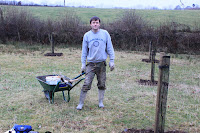
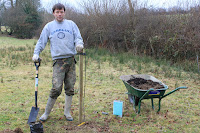
As ever planting required the use of a pickaxe and mattock so it will be interesting to see how they do in the challenging soil conditions (none appear to have died yet as I write this in late April!). Each one was staked and protected with a sheep/rabbit guard and then surrounded with a mulch to keep the grass at bay. Several weeks after we planted them we had a sheep invasion from the neighbouring field but have seen no sign of rabbits (yet).

Wednesday, 7 April 2010

Vegetables

As I mentioned in the first post, there is bugger all topsoil over the lower part of the land where we propose to plant our vegetables. During the first week here, I was determined to create at least a small vegetable patch to plant some garlic. A 4' by 6' patch took two days to double dig requiring my trusty pickaxe (recurring theme...) to break through about 6" to 12" of the local siltstone (Rab) into the underlying heavy almost white clay.

The lean-too on the back of the barn had been used to stable a horse and was covered in a 6" layer of well rotted manure. Two or three barrow load of muck were dug in with the clay in the hope it might grow something. So far so good, as the garlic appears to be doing well.

However, we decided that this was an unsustainable form of cultivation and have opted for raised beds. After a bit of trawling across the Internet, we came across Celtic Sleepers just beyond Haverfordwest and went to look at what they had. We were looking for untreated sleepers and ordered 4no. 18' long and 2no. 10' long by 12" by 6" sleepers that had come from Pembroke Dock. The 2 10' sleepers we cut in half with my new chainsaw (thanks Auntie Maggie) in about 10 seconds to make two beds. The 18' long sleepers were very heavy and had to be moved into place by balancing them on a wheelbarrow with motive power provided by No.1 Daughter Laura and boyfried Mo.


The holes left in each sleeper for the chairs were ideal to bolt them all together using M16 coach screws (the cheapest place I found was Leo Fixings). In hindsight I should have gone for 250mm long bolts rather than 200mm as they only have 50mm of bite and can't be fully tightened without stripping. However, they are not going anywhere!

The next task was to fill them. Tim from West Atherton Farm sold us 4 tonnes of topsoil which in hindsight I should have got him to tip a bit closer to the site of the beds. I lost count of how many barrow loads of soil I moved over a weekend. The base of each bed was loosened with a mattock and one bed treated to copious quantities of the aforementioned horse manure. The non-manured bed will be for root crops.

We are members of Garden Organic and the Heritage Seed Library and so buy seeds from them and obtain the 'heritage' varieties from the seed library. This Sunday we planted out the onion sets and peas in the beds and the window sill in the conservatory has trays of broad beans, french beans, tomatoes, brussel sprouts, runner beans and celery.

It is clear that we are going to run out of room this year and so are digging a few smaller beds on the other side of the road behind the mobile home which has a good depth of dark topsoil. Next year we will add further raised beds but it will be interesting to see what we can grow this year with limited space.


We cleared a large patch of brambles behind the workshop and had intended to plant potatoes there. However, it is really just broken rock (Rab again) with a bit of clay. Our agricultural consultant (Tim!) said we would be wasting our time and said even if the potatoes did grow there they would taste of the rock. He pointed to the large patch of nettles next to the raised beds and suggested that it was a former muck pile and said that would be the best place for them. Under the mat of nettle roots was about 12" of well rotted manure and has been transformed into our potato bed. We have now planted first earlies (Orla) and maincrop (Desiree).

When the weather improves and we have few (more!!) days of sunshine we will start to plant up the rest of the raised beds and the patches we have dug over the road.

Er what does this switch do?

Today we had Dave the electrician here for his third visit trying to sort out the wiring in the house. This started as a 4 to 5 hour job to replace the consumer panel but has ended up as some sort of magical mystery tour of sockets, spurs and lights to enable the wiring to be certified. It is clear that there have been several phases of wiring all done by an enthusiastic amateur with no training. Still we seem to be getting there and probably only need one more day of Dave's time, excluding the mobile home and the out-buildings!

The main thing we wanted to sort out was the wiring to the water pump in the well. The call-out on New Years Eve confirmed it was the power supply that failed and not the pump. We have therefore had an extension lead through the letter box and across the lawn ever since that started tripping out the new fuse box last week during the heavy rain.

It was agreed at the time that a new cable would be a good idea and I duly excavated a 15m long trench through rock to lay a duct for the cable. This took me two weekends of hard labour with a pickaxe. Just before Dave started to wire in the new cable, I asked him about an old switch next to the back door and we thought that it was probably redundant and could be removed. However, as it was live, Dave thought he had better trace it before cutting the cable. It was of course a switch that turned on the power to the two sockets in the well that powers the pump that I must have turned off when seeing what everything did when we moved in.

Dave also admitted that the lack of power to the conservatory that had had him stumped two weeks ago was because a switch on the skirting board in our bedroom had been turned off. Dave has promised to provide a wiring diagram when he has finished.

The moral of the story, however, is if in doubt leave it switched on!

At least I now have half the length of cable duct we need to run a proper cable to the outbuildings, however, that will undoubtedly be another saga.

Friday, 2 April 2010

The Stream


We have a small stream that runs the length of our land originating from a number of springs at the top of the field. As we get our water solely from a well and everybody that walks past the house always asks if the well has dried up, I am keen to see how the flow in the stream varies. I have therefore installed a small v-notch weir that we measure most days.

We also have a Davis Vantage Pro2 weather station so we have been recording rainfall to compare with stream flow. One thing I want to explore in the future is small-scale hydropower and so the data will be useful for that too. I have put the weather station's anemometer as high as I can to evaluate the potential for a wind turbine.

The concern about our water supply stems from the construction of the new gas pipeline from Milford Haven that passed just south of our land. Apparently the de-watering of the excavation caused the well to dry up and the tenants at the time had to rely on a temporary water supply. However, once the gas pipe was finished, the well recovered, but it does leave you wondering what would happen in a period of prolonged drought.

The stream is culverted beneath what will be the vegetable patch, the 'yard' and the road and emerges next to the mobile home. We discovered wild watercress growing in the stream at this point which is a sign of the quality of the water. I have started damming and widening the stream to encourage it to grow. This could be a potential cash crop in the future particularly if I make a couple of purpose-made beds in the field below the mobile home.

The field is low lying and very boggy. It was apparently land drained in the past by these are clearly not working now. There is a spring at the base of the bank up to a bridleway that is very active a present and has flooded most of the bottom of the field. I have therefore excavated a small channel and where there are obvious hollows created a couple of small ponds. I will also excavate a much larger pond at the very bottom of the field at some time in the future.

As we will be using wood to heat the house and our water we have planted a fast growing hybrid willow in the field. This reputedly grows at 6 - 8ft per year and can be harvested for wood on a 4 to 5 year rotation. The willows were supplied as 30cm unrooted setts (cuttings) by Bowhayes Trees and planted last week. We have planted them into a up turned sod based on the method of planting trees used by our neighbours at West Atherton Farm. According to Tim, who plants his trees into the top of a turned furrow, it gives the trees an extra depth of topsoil and suppresses the weed growth to start with. It also lifts them above the saturated soil. It will be interesting to see how they do.

Bio Diesel

Our friend Damian came to stay for a couple of days this week and drove down from Maidstone in his bio diesel fueled Audi A4. In his own words Damian has become a bit of an evangelist for bio diesel cooking it up in his back garden.

With diesel once again reaching £1.20 per litre everything Damian said makes perfect sense and for an outlay of around £700.00 he can make bio diesel at about 40p a litre. You don't need to be a rocket scientist to work out that the investment can be paid back very quickly. If you can get the raw feedstock, Waste Vegetable Oil (WVO), for free then the costs are even lower.

I therefore decided to take the plunge and yesterday approached two cafes in Narberth and have now secured a deal to collect their WVO and have agreed to pay 25p per 20 litres. This will enable us to produce diesel at about 20p per litre. I am also going to talk to a number of other cafes and restaurants in Narberth.

It will be a few months before we can afford to buy the kit, but in the meantime we have to space to store the WVO. The other issue is that whilst I have a diesel car, it is a company car and I imagine I would get in all sorts of trouble fueling it with chip fat if anything went wrong. Kim's car is petrol. We have therefore to consider changing cars at some point which is no bad thing as we really need a 4x4 capable of pulling a trailer.

If you can produce diesel at 20p per litre, it opens up lots of other possibilities. A generator will produce electricity at around 8p/kwh and we could heat a polytunnel (on the shopping list!) either with the diesel or with the WVO. As will become clear if I manage to keep this Blog up, we are looking to be as self sufficient in energy as possible and ideally get 'off-grid'.

More to follow on this.